A wattle fence is one of the simplest and most natural ways to define space in a garden, especially where a cultivated area meets woodland or open land. Made from wooden stakes and flexible branches woven together, it creates a soft boundary that feels like part of the landscape rather than something added on top of it.
Why build a wattle fence Wattle fencing is ideal when you want separation without closing things off. It clearly marks where the garden begins while still allowing light, airflow, and views through the fence. This makes it perfect for edging woodland gardens, protecting young plants, guiding paths, or defining beds without the heaviness of traditional fencing.
It is also practical. The fence helps keep foot traffic out of planted areas, discourages pets from wandering into beds, and provides subtle structure in informal or natural style gardens.
Gathering materials Wattle fencing uses simple materials that are often already available. Straight wooden stakes form the vertical structure, while flexible branches such as willow, hazel, or other young shoots are used for weaving. Branches do not need to be perfectly straight. Natural variation adds strength and character to the finished fence. Setting the posts Start by marking the line of the fence, following the natural curve of the landscape rather than forcing a straight line. Drive the wooden stakes firmly into the ground at even spacing. The posts should be deep enough to stay solid, since they support the tension of the woven branches. Once set, the posts create the framework that defines the fence shape.
Weaving the branches Begin weaving at ground level, threading branches in and out of the vertical posts. Keep the weave tight near the bottom for strength, then continue upward, alternating branch direction as you go. Slight irregularity is expected and adds to the handmade look. As the fence rises, it becomes surprisingly sturdy, even without fasteners.
Finishing and settling in Once the desired height is reached, trim excess ends or tuck them neatly into the weave. Over time, the branches will dry and tighten, locking the fence together naturally. The fence may shift slightly as it settles, which only adds to its organic appearance.
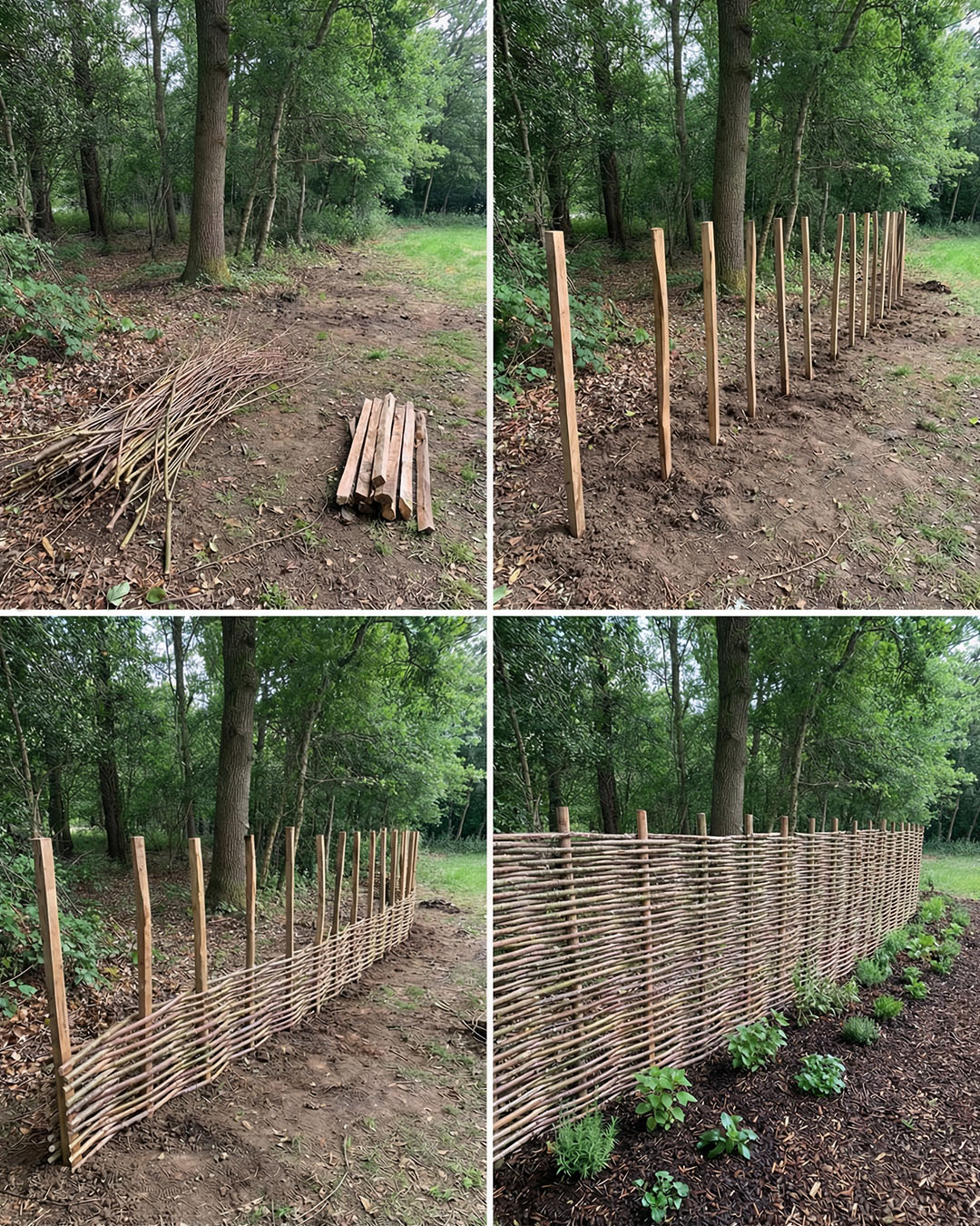
How it transforms a space Before the fence, the edge between woodland and garden often feels undefined. Afterward, there is a clear transition. On one side, structured planting and mulch. On the other, leaf litter, trees, and natural growth. The fence acts as a visual and functional boundary while still blending seamlessly into both environments.
A wattle fence does not try to dominate the garden. It works quietly, using natural materials to bring order, protection, and beauty to outdoor spaces in a way that feels timeless and grounded.