The day my father died, the entire family gathered at the old courthouse where his will was to be read.
No one cried for very long.
Not because they didn’t love him—but because everyone was wondering the same thing.
Who would inherit the farm?
Who would get the savings?
Who would own the lake cabin?
My older brother, Richard, leaned back confidently in his chair.
“I practically ran Dad’s business for the last five years,” he whispered loudly enough for everyone to hear.
My sister, Angela, smiled as she adjusted the expensive watch she insisted she’d bought herself.
“Let’s hope Dad finally appreciated who actually took care of him.”
I sat quietly in the corner.
My name is Emily.
I was the youngest.
Unlike my siblings, I never asked Dad for money.
I didn’t live nearby. I wasn’t wealthy. I worked as an elementary school teacher nearly three hours away.
But every other weekend, I drove home.
Not to discuss investments.
Not to ask for loans.
Just to drink coffee on the porch with him.
We talked about birds.
About Mom.
About baseball.
Sometimes we didn’t talk at all.
He’d simply hand me the keys to his old pickup.
“Come on,” he’d grin. “Let’s see if she’ll still start.”
The truck was older than I was.
Rust spread across the wheel wells.
The paint had faded from bright blue to something closer to gray.
The heater barely worked.
The radio only caught one country station.
Dad loved that truck.
Not because it was valuable.
Because it had carried our family through almost every chapter of life.
He drove Mom home from the hospital in it after I was born.
He taught all three of us how to drive behind its oversized steering wheel.
He hauled Christmas trees, camping gear, bicycles, and eventually furniture when we each moved away.
“It isn’t transportation,” he’d always say.
“It’s memory on four wheels.”
Everyone laughed whenever he said that.
Especially Richard.
The lawyer unfolded the will.
Most of Dad’s savings had been donated.
Part went to the local children’s library.
Another portion funded scholarships for students studying agriculture.
The family home would be sold, with the proceeds divided equally.
There was silence.
Then came the final item.
“My 1984 pickup truck,” the lawyer read, “goes entirely to my daughter Emily.”
Richard burst out laughing.
“The truck?”
Angela smirked.
“Seriously? That’s what she gets?”
One cousin whispered loudly enough for everyone to hear.
“Hope it makes it home.”
The room filled with chuckles.
I smiled anyway.
Because I’d already planned to keep it forever.
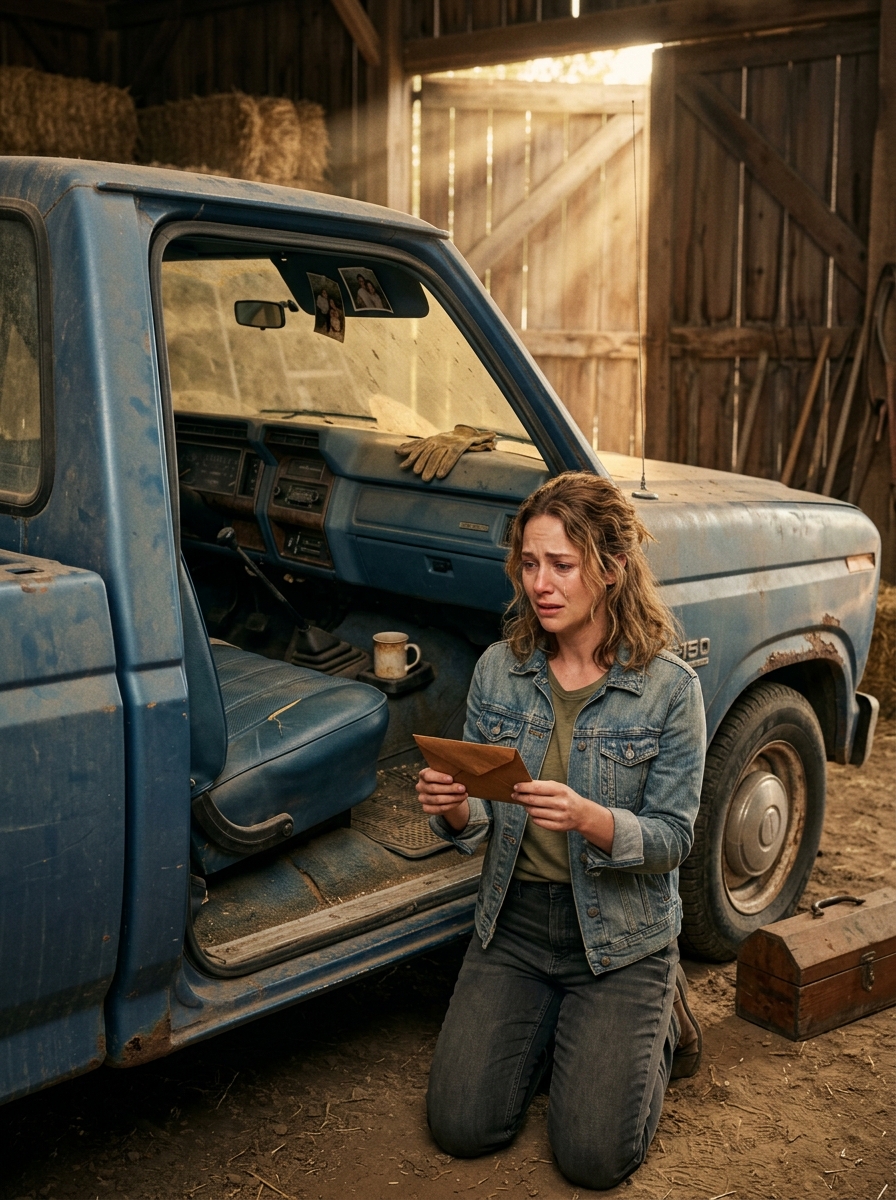
The following weekend, I drove to Dad’s barn to collect it.
Dust coated every surface.
His old work gloves still rested on the dashboard.
The faint scent of cedar, coffee, and engine oil lingered inside.
For the first time since his funeral, I cried.
Real tears.
The kind that come from missing someone who knew your heart before you ever spoke a word.
I started cleaning the truck.
Vacuuming beneath the seats.
Wiping down the cracked dashboard.
When I reached beneath the driver’s seat, my fingers touched something taped underneath.
It wasn’t metal.
It wasn’t part of the truck.
It was a weathered leather envelope.
My heart pounded.
Inside was a handwritten note.
In Dad’s familiar handwriting.
“If you’re reading this, sweetheart, then you kept the truck.”
Tears blurred the page instantly.
“Your brother would have sold it within a day.
Your sister never understood why I loved old things.
But you always knew this truck wasn’t about steel.
It was about time spent together.”
I smiled through tears.
Then I noticed something else inside the envelope.
A small brass key.
Folded beneath the letter was another note.
“Remember the old tool chest in the workshop?
Bottom drawer.
Use the key.”
I drove straight to the barn.
The tool chest stood exactly where it always had.
Its bottom drawer appeared empty.
But behind the drawer was a hidden compartment.
The tiny brass key fit perfectly.
Inside rested a small wooden box.
No diamonds.
No stacks of cash.
Just hundreds of carefully organized envelopes.
Each one labeled with a date.
Every birthday I’d ever had.
Every Christmas.
Every graduation.
Every major milestone.
Each envelope contained a handwritten letter.
Dad had written one every year since I was born.
Letters filled with advice for moments he knew he might not live to see.
One for my wedding—whether or not I ever married.
One for becoming a mother.
One for losing someone I loved.
One for turning fifty.
One simply labeled:
“For the day you think you aren’t enough.”
I opened it first.
“Emily,” he wrote.
“If you’ve opened this one, life has probably convinced you that you matter less than someone else.
Don’t believe it.
The world rewards loud people.
But kindness builds families.
You never chased my money.
You chased my stories.
That’s why you already inherited the richest part of my life.”
I couldn’t stop crying.
There were more surprises.
Tucked beneath the letters was an old notebook.
Every page documented memories.
Fishing trips.
Camping weekends.
Conversations we’d shared.
Sketches he’d drawn while waiting for me to arrive on weekends.
Pressed flowers Mom had picked decades earlier.
The notebook wasn’t worth anything at auction.
Yet it contained a lifetime.
Months passed.
One afternoon, Richard came by.
“I heard Dad hid something.”
I nodded.
“He did.”
“So…”
“Was it money?”
“No.”
He frowned.
“Then why are you smiling all the time?”
I handed him one of the letters.
He read quietly.
When he finished, his shoulders sank.
“I don’t think he ever wrote anything like this to me.”
“He might have,” I said gently.
“But maybe you never slowed down long enough for him to.”
Richard stared at the truck parked outside.
“I always thought he loved that thing more than us.”
I smiled.
“He didn’t.”
“He loved the moments we shared because of it.”
A few weeks later, Angela visited.
She asked if she could see the truck one last time.
She sat in the passenger seat, running her fingers across the cracked dashboard.
“I remember this,” she whispered.
“Dad used to sing while driving.”
Neither of us spoke for a while.
Sometimes grief arrives years after the funeral.
Sometimes healing does too.
Every anniversary of Dad’s birthday, I take the truck out for a drive.
The engine still coughs before it starts.
The radio still only plays country music.
The heater still barely works.
I wouldn’t change a thing.
Because every squeak, every dent, every mile reminds me that love isn’t measured by what someone leaves in a bank account.
It’s measured by the moments they leave behind.
People laughed when they learned my father left me nothing more than a rusty old truck.
They assumed I’d been forgotten.
What they never understood was this:
My father didn’t leave me the most valuable thing he owned.
He left me the proof that, all along, I had been the child who loved him for who he was—not for what he had.
And hidden beneath that worn driver’s seat wasn’t a fortune.
It was something far rarer.
A lifetime of love, waiting patiently for the child who would think to look.