For the last four years of our marriage, my husband never slept beside me.
At first, it happened once or twice a week.
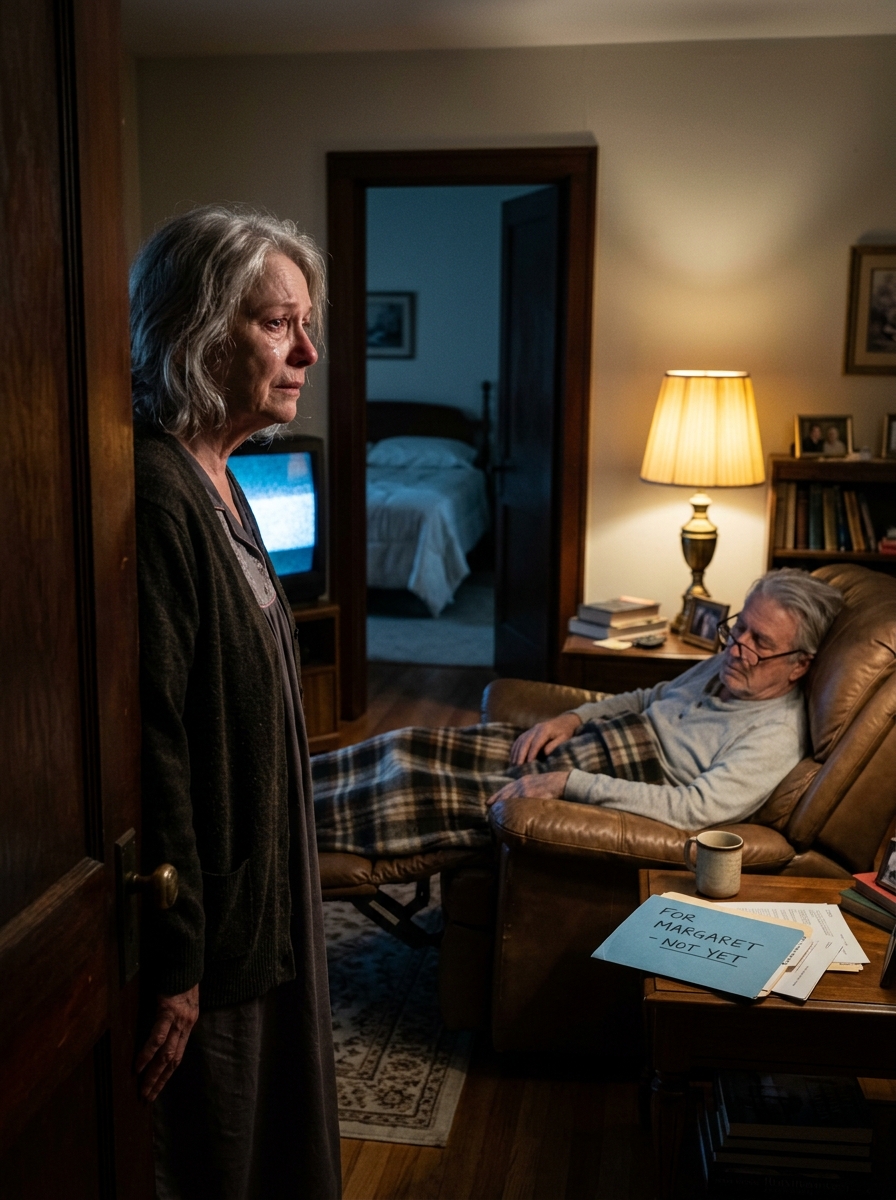
He would fall asleep in his old brown recliner while watching late-night television.
“I didn’t want to wake you,” he’d say the next morning with an apologetic smile.
I believed him.
But then it became every night.
He stopped coming to bed altogether.
No matter how many times I asked him to sleep beside me, he always had another excuse.
“My back feels better in the chair.”
“The mattress is too soft.”
“I don’t want to toss and turn.”
Eventually, I stopped asking.
After thirty-eight years of marriage, I began to wonder if this was simply what happened to older couples.
Still, the silence hurt.
The bed felt enormous.
Cold.
Empty.
Sometimes I’d wake up at two in the morning and quietly walk into the living room.
There he would be.
Blanket pulled to his chin.
Television flickering softly across the room.
His reading glasses resting crookedly on his nose.
I wanted to shake him awake.
I wanted to ask, “Why don’t you want me anymore?”
But instead, I’d simply cover him with another blanket and return to bed alone.
My name is Margaret.
I met Daniel when I was twenty-two.
He was the kind of man who remembered everyone’s birthday, rescued stray animals, and never forgot to kiss me goodbye before leaving for work.
He wasn’t perfect.
He could be stubborn.
He hated asking for help.
And he believed that if something hurt, you kept it to yourself.
“It’s not anyone else’s burden,” he’d always say.
That sentence would eventually become the greatest mistake of his life.
As the years passed, Daniel grew quieter.
He smiled less.
He walked more slowly.
He insisted he was fine.
Even after retirement, he spent most afternoons sitting in that recliner with a book in his lap.
Sometimes he wasn’t even reading.
He simply stared out the window.
I thought he was drifting away from me.
One evening, I finally asked the question I’d been carrying for years.
“Daniel…”
He looked up.
“Do you still love me?”
The pain that crossed his face lasted only a second.
Then he smiled.
“More than anything.”
I almost laughed.
“If that’s true…”
My voice cracked.
“…why won’t you sleep next to me anymore?”
He looked away.
“I just can’t.”
“Can’t—or won’t?”
Silence.
Finally, he whispered,
“I’m sorry.”
That was all.
No explanation.
No comfort.
Just two words.
I cried myself to sleep that night.
Alone.
Six months later, Daniel collapsed while trimming the roses in our backyard.
Pancreatic cancer.
Stage four.
The doctors believed he’d been sick much longer than anyone realized.
Maybe years.
He passed away nine weeks after his diagnosis.
The funeral was beautiful.
Friends told stories.
Neighbors hugged me.
Our children stood beside me through every prayer.
Yet all I could think about was that empty side of the bed.
Had he stopped loving me before he died?
Had I spent the final years of our marriage mourning a relationship that had quietly ended?
Three days after the funeral, our daughter Emily came over to help organize Daniel’s study.
His desk was immaculate.
Every pen aligned.
Every receipt filed.
Every photograph carefully framed.
As I emptied one drawer, I noticed a thick blue folder tucked beneath a stack of old tax documents.
Across the front, in Daniel’s handwriting, were four words.
For Margaret—Not Yet.
My hands froze.
Emily looked at me.
“Mom?”
I couldn’t breathe.
Slowly, I opened the folder.
Inside were dozens of medical reports.
MRI scans.
Neurologist evaluations.
Pain management notes.
Sleep studies.
Prescription histories.
None of them mentioned cancer.
Instead, every page described something Daniel had hidden from me for nearly five years.
Severe degenerative spinal disease.
Progressive nerve damage.
Chronic nighttime muscle spasms.
The reports explained that lying flat caused unbearable pain.
Some nights he could barely breathe without changing positions.
The recliner wasn’t a preference.
It was the only place he could sleep without waking up screaming.
I covered my mouth as tears blurred the words.
There was more.
A letter rested beneath the reports.
It wasn’t sealed.
It simply read,
“If you’re reading this, then I waited too long.”
I unfolded it carefully.
My Maggie,
If you’re holding this letter, I’m gone.
I’m sorry for every night you slept alone.
I know you thought I was pushing you away.
The truth is exactly the opposite.
My tears fell onto the page.
Every night I wanted to come back to our bed.
But the doctors told me my spasms would only get worse.
Sometimes I jerked so violently I nearly fell from the chair.
I couldn’t bear the thought of accidentally hurting you while you slept.
I stopped reading.
I couldn’t see through the tears.
Emily quietly left the room.
She knew I needed to be alone.
I continued.
Do you remember when you used to fall asleep with your hand resting on my chest?
I still remember every one of those nights.
I wanted them back more than anything.
Then came the sentence that shattered me.
I slept in the recliner because watching you sleep peacefully from across the room hurt less than waking you with my pain.
I cried harder than I had at the funeral.
For years I had mistaken sacrifice for rejection.
Distance for indifference.
Silence for the absence of love.
The folder contained dozens of things I had never seen.
Receipts from the jewelry store where he’d purchased my anniversary necklace.
Canceled because medical bills became too expensive.
Travel brochures for Alaska.
He’d planned the trip I’d always dreamed of taking.
A notebook filled with sketches of the porch swing he wanted to build for us.
Lists titled:
“Things Maggie still wants to do.”
“Places she smiles the most.”
“Foods she pretends not to like but always finishes.”
Every page reminded me that even while his body was failing, his heart never stopped paying attention to mine.
At the very bottom of the folder was one final envelope.
Inside was a photograph.
It had been taken secretly.
I was asleep in bed.
Morning sunlight rested across my face.
On the back, Daniel had written:
My favorite place in the world.
She never knew I watched from the recliner every night until I was sure she was sleeping peacefully.
I held that picture against my chest.
For hours.
Weeks passed before I could bring myself to move the recliner.
I didn’t donate it.
I didn’t throw it away.
Instead, I placed it beside the bedroom window.
Every evening, I sit in it for a few minutes before bed.
Not because it’s comfortable.
But because it helps me understand what Daniel endured.
Love isn’t always expressed through closeness.
Sometimes love is found in quiet sacrifices no one notices.
Sometimes the greatest acts of devotion look, from the outside, like distance.
Months later, I shared Daniel’s letter with our children.
Our son lowered his head.
“I asked Dad why he never slept upstairs anymore.”
“What did he say?” I whispered.
“He smiled and said, ‘Your mother deserves one good night’s sleep every night.'”
That sentence stayed with me.
I spent years believing my husband had fallen out of love with me.
The truth was far more heartbreaking.
He loved me so deeply that he chose loneliness over the possibility of causing me pain.
I wish he had trusted me enough to let me carry some of that burden.
I would have gladly lost sleep if it meant sharing those final years beside him.
But Daniel was the man I married—quietly strong, fiercely protective, and determined to shield the people he loved.
Now, every night before I turn out the bedroom light, I look toward the recliner by the window.
For a moment, I can almost picture him there, smiling softly, making sure I had fallen asleep before closing his own tired eyes.
And I finally understand that the empty side of my bed was never a sign that love had faded.
It was the place where an extraordinary man silently gave everything he had left to protect the woman he loved until his very last breath.