The last thing my father ever said to me was, “If you walk out that door, don’t ever come back.”
I was nineteen years old.
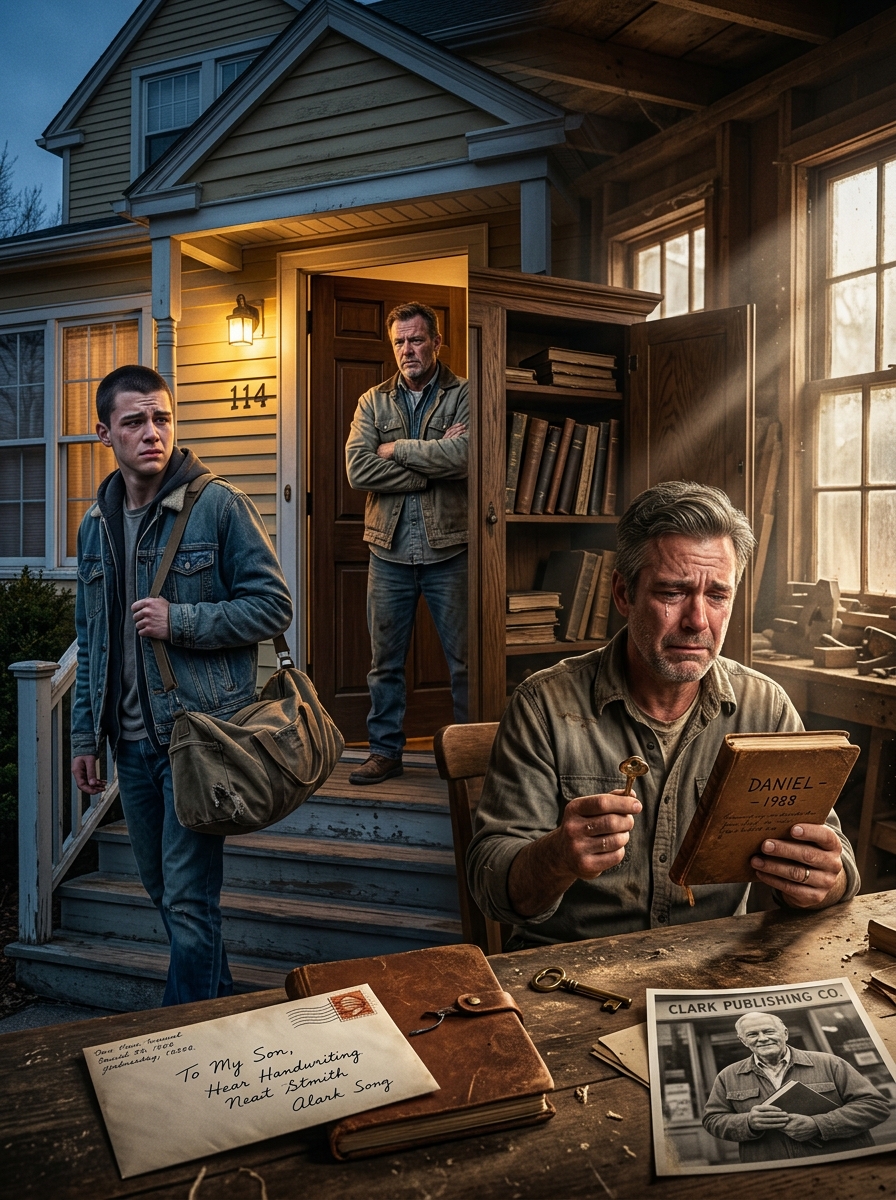
I stood in the narrow hallway of our old house with one duffel bag slung over my shoulder. My hands were shaking, but I refused to let him see it. We had been arguing for hours—about college, about my future, about the man I wanted to become instead of the one he had planned for me.
My father had spent his life running the family construction business. He expected me to take it over one day, just as he had taken it over from my grandfather.
But I wanted something different.
I wanted to study journalism.
I wanted to tell stories.
To him, that sounded like throwing my life away.
“You’ll come crawling back,” he said, folding his arms across his chest.
“I won’t.”
He stared at me for a long moment before pointing toward the front door.
“Then leave.”
I waited for him to stop me.
He didn’t.
I stepped outside.
The door slammed behind me.
That sound echoed in my head for the next thirty years.
Life wasn’t kind in the beginning.
I slept on friends’ couches, worked late-night shifts washing dishes, stocked grocery shelves before sunrise, and attended community college one class at a time.
There were nights when I wondered if my father had been right.
But each time I thought about giving up, I remembered the look on his face the day he told me to leave.
I couldn’t go back.
Eventually I earned my degree.
I became a newspaper reporter, then an editor, and years later, I started my own small publishing company.
I wasn’t rich.
But I had built a life that belonged to me.
I married an elementary school teacher named Hannah, and together we raised two wonderful daughters.
People sometimes asked about my parents.
I’d smile politely and say, “We lost touch years ago.”
It was easier than explaining that my father had erased me from his life.
Over the years, I wrote letters.
Birthday cards.
Christmas cards.
When my daughters were born, I mailed photographs.
When Hannah and I celebrated our twentieth anniversary, I sent another letter.
Every envelope came back unopened.
Return to Sender.
After a while, I stopped trying.
Not because I stopped caring.
Because rejection hurts less when you stop expecting anything.
Then one rainy Tuesday morning, thirty years after I left home, my phone rang.
“Is this Daniel Carter?”
“Yes.”
“My name is Margaret Wells. I’m the executor of your father’s estate.”
I nearly dropped the phone.
“My father?”
“I’m very sorry to tell you that he passed away three weeks ago.”
I didn’t know what to feel.
Sadness.
Anger.
Relief.
Nothing.
Everything.
She continued.
“He left specific instructions that you be contacted personally. There’s something he wanted you to receive.”
I laughed bitterly.
“After thirty years?”
“I’m afraid that’s all I can say over the phone.”
A week later, I stood outside the same house I’d walked away from as a teenager.
It looked smaller than I remembered.
The white paint had faded.
The porch leaned slightly to one side.
The maple tree I had climbed as a child towered over the yard.
Margaret greeted me at the door.
She handed me a small brass key.
“This is what your father left.”
“Just…a key?”
“He said you’d know where it belonged.”
I didn’t.
At least, not immediately.
Then a memory surfaced.
The old workshop behind the garage.
The workshop smelled exactly as it always had—wood, oil, and sawdust.
Everything was covered in dust except one old oak cabinet tucked into the corner.
The brass key fit perfectly.
Inside wasn’t money.
There were no deeds.
No jewelry.
Instead, the cabinet was filled with dozens of journals.
Every one dated.
Every one written in my father’s handwriting.
The earliest entry began the night I left.
“Daniel walked out today. I told myself I was teaching him strength. Instead, I think I may have lost my son.”
I had to sit down.
For the next several days, I read every journal.
Each one shattered the image I had carried of my father for three decades.
He wrote about watching my graduation announcement in the newspaper.
“I bought six copies.”
He wrote about secretly attending one of my public lectures and sitting in the back where I wouldn’t recognize him.
“He speaks with confidence. I’m proud of him…though I have no right to be.”
He wrote about my wedding.
“I parked across the street. I watched him smile. I wanted to walk inside, but after what I’d done, I couldn’t.”
He had seen my daughters.
Not by meeting them.
By quietly watching them play in the park from a distance after recognizing them from the photographs I had once mailed.
“I wanted to introduce myself as Grandpa. I stayed in my car.”
Tears blurred the pages.
Then I reached a journal from fifteen years earlier.
It revealed something I never expected.
The year I left home, my father had been diagnosed with an aggressive heart condition.
His doctors warned him that stress could kill him.
He never told anyone.
Not even me.
The family construction company was collapsing under debt.
He believed if I stayed, I would inherit financial ruin instead of opportunity.
He wrote:
“If Daniel hates me, he’ll build a life somewhere else. If he stays because he loves me, I’ll drag him into this disaster.”
He had chosen to make me leave.
Not because he didn’t love me.
Because he believed it would save me.
It was the worst decision of his life.
And he knew it.
The final journal was written only five days before he died.
His handwriting shook.
“If you’re reading this, then I ran out of courage while I was alive.”
“Every birthday, every Christmas, every achievement of yours—I celebrated alone.”
“I thought there would always be another year to fix us.”
“There wasn’t.”
Folded inside the last page was a photograph.
It was one I had never seen.
My father was standing outside my publishing office.
He looked older.
Grayer.
He was smiling.
On the back he had written:
“I finally saw the life you built. You were right. I was wrong. I’ve been proud of you every single day.”
Margaret found me sitting alone in the workshop.
“There’s one more thing,” she said softly.
She handed me a sealed envelope.
Inside was a letter addressed simply:
To My Son.
It read:
“Love isn’t always loud, Daniel.”
“Sometimes weak men mistake pride for strength.”
“I did.”
“I thought protecting you meant pushing you away.”
“Instead, I spent thirty years watching life through windows I no longer deserved to enter.”
“If forgiveness still exists, I hope you’ll find it—not because I earned it, but because carrying this pain any longer would only hurt you.”
“Tell my granddaughters I loved them before I ever met them.”
“And know this…”
“The greatest accomplishment of my life was never the business.”
“It was being your father.”
“I just realized it far too late.”
I never had the chance to tell him I forgave him.
But I visit his grave every year.
Not because the past disappeared.
It didn’t.
Some wounds never fully heal.
But I no longer remember the sound of the front door slamming.
Instead, I remember a frightened father who made a terrible mistake, believing sacrifice and silence were the same as love.
His journals taught me something I wish we had both understood decades earlier:
Love that is never spoken can become a lifetime of regret.
So now, before my daughters leave my house after every visit, I hug them tightly.
And I always say the words my father and I lost thirty years without hearing:
“I love you. No matter where life takes you, you’ll always have a home with me.”