“YOU ARE A DISGRACE TO THIS FAMILY,” my husband hissed, his grip tightening on my bruised arm as he forced me to stand. “Keep smiling. If the press sees you falter, you’ll pay for it.”
His fingers dug into the soft flesh just above my elbow, right where a faint, yellowish bruise was already blooming from a similar ‘correction’ two days prior. I blinked through the haze of a dizzying contraction, trying to focus on the man standing before me. This was Garrett Harrison. The man I had married. The man who, three years ago, had sat across from me in a cramped, sunlit Brooklyn coffee shop, drinking black coffee and laughing at the absurdity of his family’s generational wealth. Back then, I was Audrey, a self-made, fiercely independent graphic designer running a successful boutique agency in SoHo. I had believed his rebellious facade. I had believed he shared my progressive values, my disdain for the hollow pageantry of the elite.
I had been entirely, disastrously wrong.
The mask began to slip the moment his father’s health declined. Arthur Harrison, the tyrannical billionaire patriarch of the Harrison Group, had summoned his prodigal son home, and Garrett had regressed with terrifying speed into the archaic, patriarchal mold of his bloodline.
The dining room of the Harrison Estate in Connecticut was cavernous and perpetually cold, smelling suffocatingly of polished beeswax and expensive white lilies—a scent I would forever associate with living death. I stood at the edge of the sprawling mahogany table, thirty-four weeks pregnant, my knuckles white as I gripped the wood. A severe, painful contraction rolled through my lower back, stealing the breath from my lungs.
“Garrett, please,” I whispered, my voice trembling as the pain spiked. “The doctor said I need strict bed rest. My blood pressure is skyrocketing.”
Garrett didn’t look up from the glowing screen of his phone. He was meticulously reviewing the guest list for his father’s upcoming lifetime achievement gala, his jaw set in a hard, uncompromising line. “The obstetrician is being dramatic, Audrey. My mother attended three galas the week I was born. You’re a Harrison now. You don’t get to hide in bed when the family is on display.”
From the far side of the room, a dry, grating chuckle echoed off the wood-paneled walls. Samantha Harrison, Garrett’s older sister, was lounging on a velvet settee, idly swirling a glass of vintage champagne. She was a woman carved from ice and entitlement.
“Honestly, Audrey, stop playing the fragile victim,” Samantha drawled, her upper lip curling in disdain. “It’s unsightly. Dad expects everyone at that head table tonight. If you’re not there, the board will start asking questions about Garrett’s stability. We can’t have the shareholders thinking he can’t even control his own pregnant wife.”
Control. That was the word they used now. Under the guise of protecting the family’s privacy, they had systematically isolated me. They had dismissed my agency’s clients, canceled my personal phone plan, and replaced my long-time OB-GYN with a private family physician who answered only to Garrett.
I reached out, my trembling hand brushing the sleeve of Garrett’s bespoke tailored suit. “I am bleeding, Garrett. Just a little, but the doctor said—”
Garrett pulled his arm away with a look of profound, visceral disgust, brushing his sleeve as if my touch had soiled the fabric. “Do not make a scene, Audrey. You will put on the gown we bought, you will wear the family diamonds, and you will stand by my side tonight. If you can’t manage that simple duty, I will start questioning why I married a woman of your class in the first place.”
I stared at him, the man who was supposed to be the father of my child, and saw absolutely nothing but a hollow vessel of ego and greed. He didn’t care if I collapsed. He didn’t care if our baby survived. He only cared about the optics.
As I slowly let go of the table and stood up to prepare for the gala, a sharp, white-hot pain suddenly tore through my abdomen, so violent it blinded me. It was immediately followed by the terrifying, unmistakable sensation of warm fluid rushing heavily down my legs, soaking into the antique Persian rug, just as the heavy, brass house phone on the credenza began to ring with the frantic news that Arthur Harrison had just suffered a massive, fatal stroke.
Chapter 2: The Breaking Point
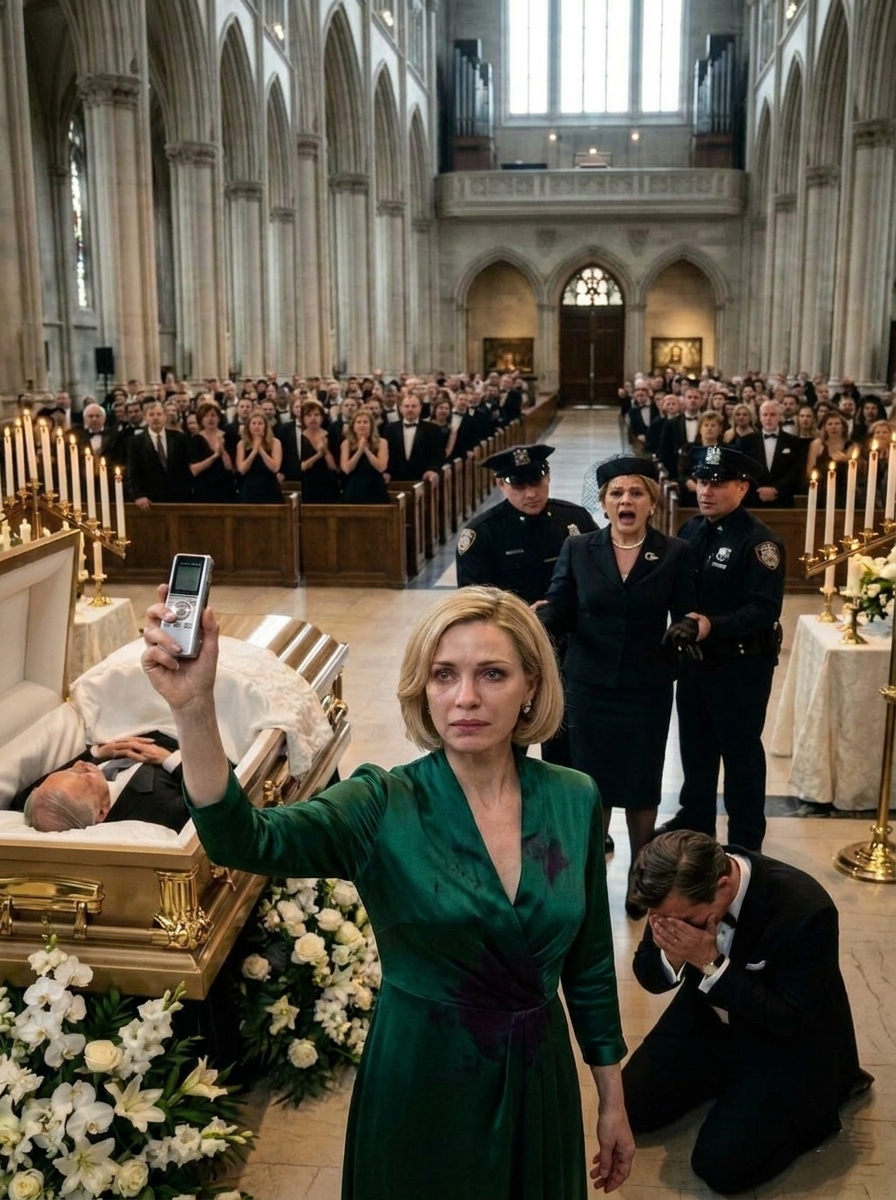
The air in the grand nave of the cathedral was suffocatingly heavy with the cloying scent of thousands of white roses. The sheer volume of the flowers was an ostentatious display, a wall of floral rot attempting to mask the scent of death and moral decay. My vision blurred, graying at the edges as I stood on the unforgiving, cold marble floor.
It had been barely forty-eight hours. Forty-eight hours since the emergency squad rushed me from the estate. Forty-eight hours since the violent, traumatic emergency C-section that had saved my daughter’s life while nearly extinguishing my own.
I was drowning in physical agony. My surgical dressings were completely soaked through. With every agonizing micro-movement, I could feel the thick, warm pull of postpartum blood dripping down my inner thighs, pooling uncomfortably in the soles of my designer heels. At my feet, bundled in a stark white carrier, my newborn daughter, Maya, wailed softly, her tiny voice a heartbreaking vibration against my numb calves.
The funeral was a state-like affair, completely disregarding the medical emergency I had just survived. Garrett had stormed into my recovery room, flanked by private security, and demanded I be discharged against medical advice. The family must appear united, he had ordered. And so, I was dragged out of a hospital bed, stuffed into a restrictive black designer mourning dress that scraped mercilessly against my fresh abdominal incision, and positioned like a lifeless prop next to Arthur Harrison’s solid gold casket.
“Garrett,” I gasped, my voice barely a rasp. My knuckles were bone-white as I gripped the side of the heavy gold casket. If I let go, I would collapse. “I need to sit down. My stitches… I think they’re tearing. I’m bleeding through my dress.”
“Stand up straight,” Garrett hissed through clenched teeth. He didn’t even turn his head. His eyes were fixed dead ahead on the bank of television cameras broadcasting the service live to a global audience. “The governor is looking this way. Sitting down is disrespectful to my father’s memory. You will stand here until the last eulogy is read.”
A wave of nausea washed over me, metallic and thick. Maya’s wails began to pitch higher, transforming into the desperate, hungry cries of an infant in distress. Desperate, my mind fraying at the edges, I turned to Samantha. She stood a few feet away, looking pristine and untouchable in a structured black Dior suit, her face veiled in dark netting.
“Samantha, please,” I whispered, my voice cracking, tears of absolute physical torment finally spilling over my lashes. “Just hold Maya for five minutes. Just five minutes so I can go to the restroom and change my dressings. I beg of you.”
Samantha paused, slowly turning her veiled head toward me. She glanced down at the crying infant at my feet, her upper lip curling in a sneer so visceral it belonged on a feral animal.
“Put the brat on the floor, Audrey,” Samantha scoffed softly, ensuring the microphones wouldn’t catch her venom. “Grandpa’s legacy matters more than your messy bodily functions. If you can’t handle a basic funeral, you should have left the baby at the hospital.”
In that exact, fractured second, the universe seemed to stop spinning. The deafening hum of the cathedral, the murmurs of the elite crowd, the oppressive smell of the roses—it all vanished.
Something inside of me fundamentally snapped.
The searing, white-hot pain in my lower abdomen suddenly went ice-cold. The desperate, suffocating fear that had dictated my every move for the past nine months, the pathetic desire to please these monsters, evaporated into the heavy air. In its place, a hard, crystalline rage crystallized in my chest. It was pure, unadulterated clarity. I looked at my husband’s cold, arrogant profile, completely indifferent to my bleeding. I looked at Samantha’s sneering face, disgusted by the very life her brother had helped create.
They are not human, my mind whispered. They are hollow.
“On the floor,” I repeated. My voice didn’t sound like my own. It was dead, flat, and devoid of any lingering submissiveness.
“Yes,” Samantha scoffed, turning her attention back to the altar. “Now shut up and show some respect.”
I did not cry. I did not plead anymore. Instead, I carefully, agonizingly bent down, ignoring the agonizing rip of sutures in my belly. I picked up my crying baby, pressing her warm little body against my chest, and turned my back on the casket. Slowly, but with an unwavering, terrifying steadiness, I began to walk toward the altar.
I bypassed the family pew entirely, stepping up the velvet-lined stairs onto the raised marble platform. I grabbed the heavy silver microphone meant for the governor’s upcoming eulogy. I didn’t look back at Garrett’s suddenly panicked, bloodless face as I pulled my phone from the pocket of my dress, plugged it into the auxiliary cable of the state-of-the-art sound system, and pressed ‘play’.
Chapter 3: The Revelation and the Escape
A high-pitched screech of feedback from the microphone echoed through the vaulted ceilings of the cathedral, violently slicing through the somber atmosphere and instantly silencing the soft murmurs of the two thousand high-society guests.
Then, a voice boomed from the massive, hidden speakers mounted along the stone pillars. It was Garrett’s voice. Crisp, clear, and utterly devoid of warmth.
“Once the baby is born, we’ll claim she has severe postpartum psychosis.”
A collective gasp rippled through the pews. It sounded like the rushing of a sudden wave.
“I’ve already spoken to Dr. Sterling’s replacement at the clinic,” the recorded Garrett continued, his tone chillingly conversational. “He’ll sign the involuntary commitment papers. Audrey will spend the rest of her life in a quiet facility upstate, and she won’t be able to touch a dime of the heir trust.”
I had found the recording on the digital baby monitor three days ago. They thought I was asleep in the nursery, too exhausted by the pregnancy to notice the red recording light blinking in the shadows. They thought my isolation had made me stupid.
Down on the floor, Garrett’s face drained of all color, leaving him looking like a freshly embalmed corpse. He took a stumbling step toward the altar, his mouth opening and closing soundlessly, but the sheer, paralyzing shock of his own voice echoing through the house of God rooted him to the spot.
Then, Samantha’s voice came through the speakers, loud, sharp, and dripping with malicious calculation.
“Perfect. And once she’s locked away, we can dissolve her design business and absorb her personal assets too. Dad’s estate tax is going to hit us hard, Garrett. We need that fifty-million-dollar baby allocation to keep the board off our backs. Just make sure she doesn’t suspect anything until the funeral is over.”
Pandemonium erupted. The silence shattered into a cacophony of shocked shouts, frantic whispers, and the rapid, aggressive clicking of camera shutters. The primary news cameras, positioned on a raised dais in the back to broadcast the late billionaire’s send-off, were now zooming in directly on me, capturing every second of the confession live to millions of viewers worldwide.
I stood calmly by the microphone, cradling Maya close to my chest. The warmth of her small body gave me a profound, supernatural strength. I looked out over the sea of faces—senators, CEOs, socialites—and then looked directly into the glowing red lens of the center camera.
“My name is Audrey Harrison,” I said. My voice didn’t shake. It echoed through the cathedral with chilling, absolute clarity. “And I am leaving.”
I dropped the microphone. It hit the marble floor with a heavy, deafening thud that reverberated through the speakers like a gunshot.
I turned and walked down the center aisle. The prestigious guests, the very people who had looked right through me for three years, now parted like the Red Sea. Their faces were a grotesque mixture of horror, fascination, and sudden, intense revulsion. I walked past my husband. Garrett was trembling with a catastrophic rage, his hands shaking so violently at his sides he could barely stand. He looked completely shattered, a king suddenly stripped of his castle and his crown.
I didn’t blink. I didn’t slow my pace. I pushed open the heavy, intricately carved wooden doors of the cathedral and stepped out into the biting, cold rain of the New York afternoon.
As the icy water hit my feverish skin, washing away the stench of the lilies, I heard the cathedral doors slam violently open behind me. Heavy, frantic footsteps slapped against the wet pavement. It was Garrett, sprinting after me, his voice screaming my name into the storm with a desperate, unhinged, murderous fury.
Chapter 4: The Legal Siege
The glass-walled conference room of Nathan‘s downtown office was a sanctuary of sterile, quiet power. Outside, the city was completely oblivious to the war being waged fifty stories up, but inside this room, the air was thick with the scent of impending ruin.
Garrett slammed his palms flat onto the polished glass table, the loud smack echoing sharply. His bespoke mourning suit was hopelessly wrinkled, his tie undone and hanging loosely around his neck. His eyes were heavily bloodshot, surrounded by deep, bruised circles of pure panic. Samantha stood directly behind him, her usual pristine composure utterly shattered as she bit her perfectly manicured nails raw, her eyes darting toward the frosted glass doors like a cornered animal.
“You think you’re clever, Audrey?” Garrett snarled, pointing a trembling, accusatory finger at me. Spittle flew from his lips. “You ruined my father’s funeral! You ruined our family name on national television! But you have nothing. The recording is inadmissible in half the courts in this state. Our lawyers will tie you up in litigation for the next thirty years. You’ll be broke, homeless, and I will still take my daughter from you!”
I sat calmly across from him, entirely unbothered by his theatrics. I took a slow sip from a porcelain cup of warm peppermint tea. I looked noticeably healthier than I had at the cathedral. My color was returning, the swelling in my face had gone down, and my eyes—once clouded with exhaustion and fear—were steady, bright, and devastatingly clear.
Beside me sat Nathan. I had secretly retained him weeks before my water broke, using a burner phone smuggled to me by a sympathetic housekeeper. Nathan was a brilliant, utterly ruthless pro-bono defense attorney who specialized in tearing apart financial abusers. He was the shark the Harrisons never saw circling in the water.
Nathan didn’t raise his voice. He simply smiled, a thin, predatory curve of his lips, and opened a thick, heavy manila folder on the table.
“Mr. Harrison,” Nathan said smoothly, his voice a soothing balm over Garrett’s chaotic rage. “While you were busy trying to manage the catastrophic public relations disaster at the cathedral over the past seventy-two hours, the Department of Justice was quietly reviewing the financial ledgers my client graciously provided them.”
Garrett froze. The violent shaking in his hands suddenly stopped. “What?”
“Specifically,” Nathan continued, sliding a heavily highlighted spreadsheet across the glass, “the offshore accounts in the Cayman Islands that your late father used to funnel millions in tax-exempt charity funds back into your personal shell corporations. A rather sloppy trail of breadcrumbs, I must say. The forensic accounting was almost too easy.”
Garrett stared at the paper as if it were a live grenade. The color completely drained from his face for the second time in three days.
“And as for your threats regarding custody,” I interjected, setting my teacup down. My voice was quiet, but it cut through the room like a razor blade. “The police have already obtained warrants for your arrest, and Samantha’s, for conspiracy to commit kidnapping and medical fraud. It turns out, the corrupt doctors you bribed to sign my fake psychiatric evaluation were much more interested in turning state’s evidence than losing their medical licenses and facing federal prison to protect your trust fund.”
Samantha let out a choked gasp, stumbling backward until her back hit the glass wall.
Right on cue, the heavy doors to the conference room swung open. Two federal agents walked in, their badges flashing under the fluorescent lights, their expressions completely devoid of sympathy.
“Garrett Harrison? Samantha Harrison?” the lead agent stated, pulling a pair of steel handcuffs from his belt. “You are under arrest for conspiracy, wire fraud, and grand larceny. You have the right to remain silent…”
As the cold metal handcuffs clicked brutally around Garrett’s wrists, securing his arms behind his back, reality finally shattered Samantha’s mind. She let out a piercing, unearthly shriek, lunging forward toward the table, her face contorted in an ugly mask of pure hatred.
“You bitch!” Samantha screamed, struggling as the second agent grabbed her arms. “You think you’ve won?! We still own the family estate! We own everything! I’ll burn the Connecticut house to the ground before I ever let you get a single cent of our money!”
I looked up at her, my expression completely serene. Without saying a word, I reached into Nathan’s folder, pulled out a single sheet of heavy, watermarked legal paper, and calmly slid the bank foreclosure notice across the glass table.
Chapter 5: Ashes and New Soil
The local morning news played softly on the small, battered television sitting on my new butcher-block kitchen counter. The reporter’s voice was crisp, professional, and delightfully disconnected from the drama that had consumed my life.
“…Following the catastrophic bankruptcy and subsequent liquidation of the Harrison Group, the iconic Connecticut estate was sold at a public foreclosure auction early this morning. Former corporate heir Garrett Harrison officially began his eight-year federal prison sentence today at Allenwood, while his sister, Samantha Harrison, having taken a plea deal, was sentenced to five thousand hours of grueling community service and ordered to pay full financial restitution to the victims of the charity fraud scheme…”
I smiled softly, picked up the remote, and clicked the television off. The silence that followed was not the heavy, oppressive silence of the Connecticut mansion. It was a light, breathing silence.
I walked over to the kitchen sink and looked out the window. Outside, the rugged, rocky coastline of Camden, Maine, stretched out before me. The morning sun was just beginning to break through the thick, salty sea fog, casting a warm, brilliant golden glow over the wild, untamed sea grass that surrounded my modest, sunlit wooden cottage. The air smelled fiercely of salt, pine needles, and absolute freedom.
In the living room behind me, Maya, now a robust, fiercely energetic one-year-old, let out a bubbling laugh as she pushed a brightly painted wooden duck across the soft, hand-woven rug. I wiped my hands on a dish towel, walked over, and scooped my daughter into my arms. I buried my face in her soft curls, inhaling deeply. She smelled of sweet, clean baby shampoo and warm milk.
She is safe, I reminded myself, my heart swelling with a fierce, protective love. We are finally safe.
I carried her out to the back porch, letting the cool ocean breeze wash over us. There were still deep scars on my body. The long, jagged silver line of my surgical incision resting low on my abdomen was a permanent, physical reminder of the night I had almost died on the altar of the Harrison family’s ego. Sometimes, when the weather turned cold, the scar tissue ached.
But the soul-crushing pain was entirely gone. The constant, heavy dread that had lived like a lead weight in the center of my chest for years had been permanently replaced by a quiet, unbreakable, solid peace. I had lost the luxury of the Connecticut mansion. I had lost the designer clothes, the private jets, and the illusion of the perfect high-society marriage.
But I had gained my life. I had gained my daughter. And, most importantly, I had reclaimed my own soul.
As I set Maya down on the porch to let her play with a pile of smooth sea glass we had collected the day before, my eyes drifted to the small, wrought-iron patio table. Resting precisely in the center of the table was a thick, cream-colored certified letter that the postman had delivered an hour ago.
It was from an anonymous, highly exclusive legal firm based in Zurich. My fingers trembled slightly as I reached for it, breaking the heavy wax seal. Inside, wrapped in velvet, was a heavy brass key, and a typed address to a heavily guarded private subterranean vault in Switzerland—a hidden, unlisted account containing the original seed money from my absorbed design business, quietly moved by a sympathetic accountant years ago, that neither Garrett, Samantha, nor the federal investigators had ever discovered.
Chapter 6: The True Legacy
The grand auditorium in downtown Boston was filled to capacity, buzzing with the quiet, respectful energy of hundreds of attendees. Above the main stage, hanging from the high rafters, a massive, brilliantly lit banner read in bold, sweeping letters: The Sanctuary Foundation: Protecting Mothers, Saving Children.
I stood patiently behind the polished oak podium, adjusting the microphone. I was wearing a simple, impeccably tailored navy blue suit. My hair was pulled back into a sleek twist, and as I looked out at the sea of faces, I felt a profound, radiant brightness in my chest. The trembling, terrified woman who had bled onto the marble floors of a cathedral felt like a lifetime ago.
It had been five years since the collapse of the Harrison empire. Using the recovered funds from the Zurich vault, I hadn’t returned to graphic design. Instead, I had built something entirely new from the ashes of my trauma. The Sanctuary Foundation provided immediate, aggressive legal defense, covert extraction teams, and full financial relocation support for pregnant women and postpartum mothers trapped in highly abusive, wealthy, or powerful domestic situations. We were the shield that I had so desperately needed.
I scanned the front row and smiled. There, sitting next to a very proud-looking Nathan, was Maya. She was now a thriving, impossibly bright six-year-old. She wore a bright yellow dress, her legs swinging happily over the edge of her chair, clapping enthusiastically as she looked up at me. Her eyes were shining with unrestrained pride. She was a child entirely, beautifully free from the toxic shadow of the Harrison legacy.
The applause died down, and I leaned into the microphone.
“Five years ago,” I began, my voice steady, resonant, and echoing clearly through the massive hall, “I was told by the people who were supposed to be my family that a legacy of wealth mattered far more than human life. I was told that maintaining the illusion of perfection and showing respect to the dead was infinitely more important than protecting the living.”
I paused, letting the silence hold the weight of those words. I looked directly at the mothers sitting in the audience, seeing my own past reflected in their surviving eyes.
“But through fire, through blood, and through the sheer, unstoppable force of a mother’s love, I learned the truth,” I continued, my voice rising with conviction. “I learned that a true legacy is not made of solid gold caskets. It is not made of hidden offshore accounts, or empty, rotting social prestige. A true legacy is built on the unwavering safety we provide for our children. It is built on the absolute respect we demand for our own bodies. And it is forged in the terrifying courage we find to stand up, to speak the truth, precisely in the moments we are expected to fall.”
The crowd erupted. It started as a ripple and exploded into a deafening, thunderous standing ovation. Women were weeping, men were cheering. I looked down at Maya, who stood up on her chair and blew me an exaggerated, joyful kiss. I caught it and pressed it to my heart.
Later that evening, after the gala had ended and the crowds had dispersed, I walked slowly along the quiet, moonlit beach near our home in Maine. The tide was low, the gentle waves crashing softly against the dark shore, leaving delicate, glowing white foam resting on the wet sand. I held Maya’s small, warm hand in mine.
“Mommy,” Maya asked softly, her voice carrying over the rhythm of the ocean as she looked up at the vast, starry sky. “Are we safe here?”
I stopped walking. I kneeled down in the damp sand, ignoring the cold, and looked my beautiful, perfect daughter directly in her bright eyes. I traced the soft curve of her cheek, feeling the pulse of life beneath her skin.
“We are safe, my love,” I smiled, the truth ringing with absolute certainty in my soul. “We will always be safe.”
As she giggled and ran a few steps ahead to chase a retreating wave, I stood up and looked out at the endless expanse of the dark ocean one last time. The heavy ghosts of Connecticut, the sneers of my abusers, the cold marble of the cathedral—they dissolved into the sea mist, completely and finally letting go of me. The past was dead, buried in its gilded cage, and I knew, with every breath in my lungs, that the bright, boundless horizon ahead belonged entirely to us.